




























Views
Downloads

Essential Symbiotic Relationships Sorting - Grade 6-9 Ready

Paste this activity's link or code into your existing LMS (Google Classroom, Canvas, Teams, Schoology, Moodle, etc.).
Students can open and work on the activity right away, with no student login required.
You'll still be able to track student progress and results from your teacher account.
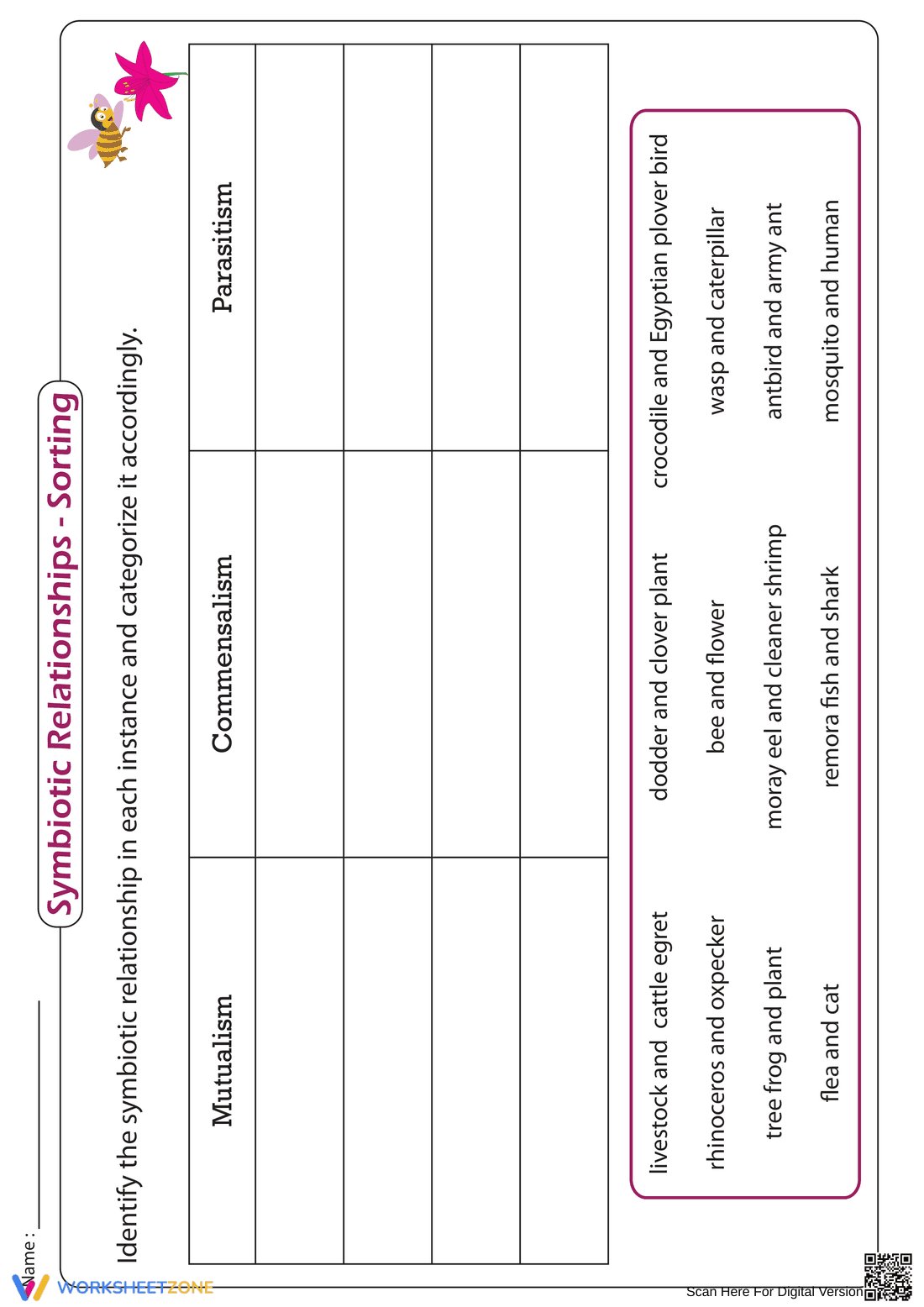
Mastering ecosystem dynamics starts with identifying how organisms interact within their habitats. This symbiotic relationships sorting worksheet challenges middle school students to classify 12 distinct biological pairings into mutualism, commensalism, and parasitism. By analyzing real-world examples, learners develop a concrete understanding of interdependencies and their roles in evolutionary biology.
At a Glance
- Grade: 6-9 · Subject: Living Things
- Standard:
MS-LS2-2— Predict patterns of interactions among organisms across multiple ecosystems- Skill Focus: Classification of Symbiotic Relationships
- Format: 1 page · 12 problems · Answer key included · PDF
- Best For: Independent practice or quick formative assessment
- Time: 15–20 minutes
This focused classification resource features a structured three-column table designed for high-contrast organization. Below the categorization grid, a specialized word bank provides 12 specific organism pairs, ranging from the well-known bee and flower to the more complex relationship between the dodder and clover plant. The single-page layout ensures that all necessary information remains visible to the student during the sorting process, minimizing cognitive load while maximizing content engagement.
This resource allows for immediate classroom implementation with a teacher preparation time of under 2 minutes. First, print the single-page PDF. Second, distribute the worksheet to students for independent or paired sorting. Finally, use the included answer key for rapid whole-class review. Its self-explanatory instructions make it an ideal emergency sub plan or "bell ringer" activity for middle school life science teachers.
The primary alignment for this activity is `MS-LS2-2`, which requires students to construct explanations predicting patterns of interactions across ecosystems. By categorizing relationships like parasitism and mutualism, students demonstrate their ability to distinguish between beneficial and harmful interdependencies. This standard code can be copied directly into lesson plans, IEP goals, or district curriculum mapping tools to ensure rigorous adherence to life science frameworks.
For optimal results, assign this worksheet as a formative assessment after an introductory lecture on symbiosis. Teachers should observe students during the sorting process, noting if they struggle to differentiate between commensalism and mutualism. Expected completion time is 15-20 minutes, making it a perfect transition activity. Use the results to identify if specific pairs, such as the remora fish and shark, require additional direct instruction or visual aids.
This resource is specifically tailored for students in grades 6 through 9 who are exploring ecological patterns. The inclusion of a word bank provides necessary scaffolding for English Language Learners and students with IEPs, while the diverse range of organisms offers enough challenge for general education biology classrooms. It pairs naturally with a digital presentation on biomes or a textbook chapter on community interactions.
Effective science instruction relies on active classification to bridge the gap between abstract concepts and empirical observation. Research from RAND AIRS 2024 emphasizes that structured sorting tasks in middle school science promote higher retention of biological terminology and ecological patterns. By engaging with `MS-LS2-2` through this classification exercise, students move beyond memorization toward the predictive reasoning required by science standards. The 12 organism pairs represent a scientifically vetted cross-section of interdependencies, including commensalism, mutualism, and parasitism. This approach aligns with evidence-based practices, providing a rigorous yet accessible entry point for analyzing complex evolutionary forces. Educators can trust that these structured problems facilitate the gradual release of responsibility, moving students from guided identification to independent mastery of complex organism interactions within diverse ecosystems across the globe.


